
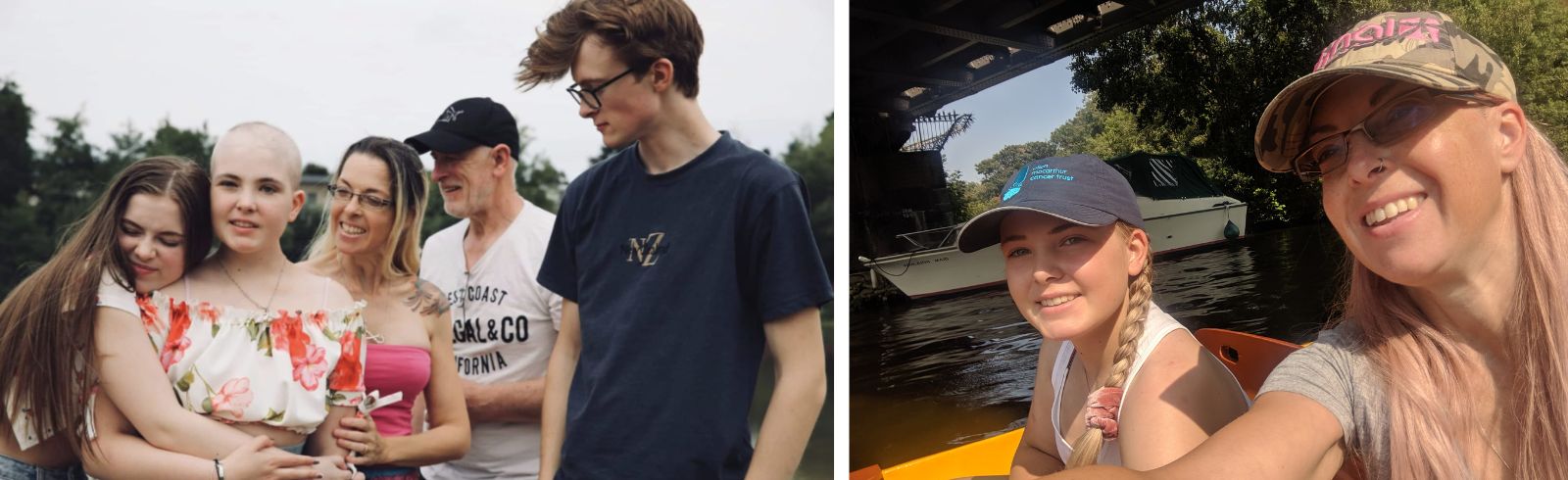
Buckinghamshire teen Grace was just 14 when she died of a glioblastoma in November 2020. Her symptoms were first dismissed as hormonal, but when they worsened, mum Rebecca pushed for further tests. Despite treatment and a clinical trial, the cancer was too aggressive. Now, Rebecca is sharing Grace’s story to call for greater investment in research into brain tumours.

Here is Grace’s story, as told by her mum, Rebecca…
Grace’s symptoms started in February 2018. We were out walking the dog and as she looked up at the sky she described seeing a kaleidoscope of colours. That happened infrequently, over the next two months.

In April, I took her to the GP who suggested it could be hormone related, tiredness and silent migraines. I suffer with silent migraines and thought that mine were nothing like what Grace had described. At the time, Grace was 12, I wasn’t convinced it was her hormones causing her symptoms and I kept a list of everything she was telling me she was experiencing.
Soon after, she developed a pins and needles sensation in her arm which we thought was possibly from not writing for a long period of time, but this soon happened more regularly.
On the hour every hour, Grace described what we later found out were sensory seizures.
She told us it felt like there were tears falling down the left side of her face but there was nothing. She said it felt as if her skin was being pulled off from the left side of her body. She felt electric shocks on her left hand and felt as if her eyes were being gauged out.
We went to Stoke Mandeville Hospital A&E where nothing abnormal was found. We went home but Grace continued to have these seizures. We called an ambulance and were told because she had been diagnosed with silent migraines there was nothing they could do.
In May, Grace was having prolonged sensory seizures. We called an ambulance, and, on the way, Grace had a tonic-clonic seizure during the journey. We arrived at the hospital, and I told the medical team that I thought Grace had a brain tumour.
Results of an MRI were somewhat inconclusive. At the time I was working in the fitness industry having spent six years as a paediatric nurse and saw what looked like a mass on the image, which I was told was swelling due to a virus. She remained in hospital and was treated for viral encephalitis.
During a six-week period in hospital, Grace was having audio and visual hallucinations.
She saw dark figures jumping out and internally played back different sounds and voices which interrupted her day.
Eventually Grace was discharged with cortical dysplasia, a condition which can impact the brain’s function. My instinct was telling me there was something else responsible for Grace’s ever building list of symptoms. I kept her home where I could keep an eye on her.
During our first week home, I emailed every neurosurgeon I could get contact details for and wrote out everything that had happened to Grace up until that point. A neurosurgeon at John Radcliffe Hospital in Oxford invited Grace for an EEG, which uses electrodes on the scalp to detect brainwave patterns, and 24-hour video monitoring. As soon as she was hooked to the machine, the results showed her brain was in a state of epilepsy. I told the team about my concerns that Grace had a brain tumour, and they replied, ‘I think you’re right’ shortly before it was confirmed with a biopsy.
It took four months to get to this point, and was hard for the whole family, especially Grace as I feared she thought people thought no one believed what was happening to her.

Grace’s tumour was deep in her brain, and we were transferred to Bristol Royal Hospital for Children so they could use a stereotactic robotic arm to help gather a sample of the tumour for biopsy. We had so many questions about what was happening and what having a brain tumour meant, but we were met with silence as doctors continued to investigate.
When we got the results, we were devastated. The tumour was an inoperable glioblastoma which was half the size of her brain. The doctors said they didn’t know how Grace was still functioning.
Throughout everything, Grace was positive.
She knew she was terminal and that she would be lucky to survive the next five years.
She responded well to radiotherapy, undergoing temozolomide (TMZ) chemotherapy at the same time. Within two weeks her seizures stopped, and we had one very good year. She went back to school as much as she could, averaging three afternoons each week. She enrolled in air cadets, took up dancing, horse riding and taught herself how to play the drums and keyboard. She grabbed life and we made memories.

I used to hate that term ‘making memories’. I hated the fact that we had to think to store these memories instead of living in the moment. The significance of what we were doing had to last a lifetime.
Grace was stable up until Boxing Day 2019 when her sensory seizures began once again and she told me she had a salty taste in her mouth.

She was placed on a different type of chemo called etoposide, and treatment became palliative. The side effects were hideous and after two months she came off it. She lacked energy, developed mouth ulcers and couldn’t eat for herself, she had no quality of life, it felt barbaric to continue.
We explored other therapies alongside the NHS; microdosing THC and CBD cannabinoids and even looked at going to Mexico for immunotherapy but there was nothing suitable for Grace.

A place became available on the PARC trial at Birmingham Children’s Hospital. The trial was an early-stage international study testing whether depriving brain tumours of the amino acid arginine could slow their growth.
After two months she had to stop as her condition worsened, and she didn’t want to go through another MRI.
The trial used a different drug, but the approach is similar to the work being done at the Brain Tumour Research Centre of Excellence at Imperial College London – finding new ways to treat aggressive brain tumours like hers.
Grace made it home where she and her two siblings spent time together before she died on 2 November 2020.

Throughout Grace’s diagnosis, we made sure she was part of every decision. She was extremely brave, and we wanted to respect her input in what was happening to her.

Brain Tumour Research is such an important organisation because it’s educating people on the disease and campaigning for more funding in research into brain tumours. We are a long way off, but we’re getting there in finding kinder treatments. That’s why I’m taking part in 88 Squats a Day in July which I saw on Facebook. I’m doing it in between studying Biology, Chemistry and Physics A Levels to allow me to begin a degree in pharmacology, something I’ve always thought about doing.
Rebecca Gaskell
July 2025
One in three people in the UK knows someone affected by a brain tumour. This disease is indiscriminate; it can affect anyone at any age. What’s more, brain tumours continue to kill more children and adults under the age of 40 than any other cancer yet, to date, just 1% of the national spend on cancer research has been allocated to this devastating disease since records began in 2002.
Brain Tumour Research is determined to change this.
If you have been touched by Grace’s story, you may like to make a donation via www.braintumourresearch.org/donate or leave a gift in your will via www.braintumourresearch.org/legacy
Together we will find a cure.
