
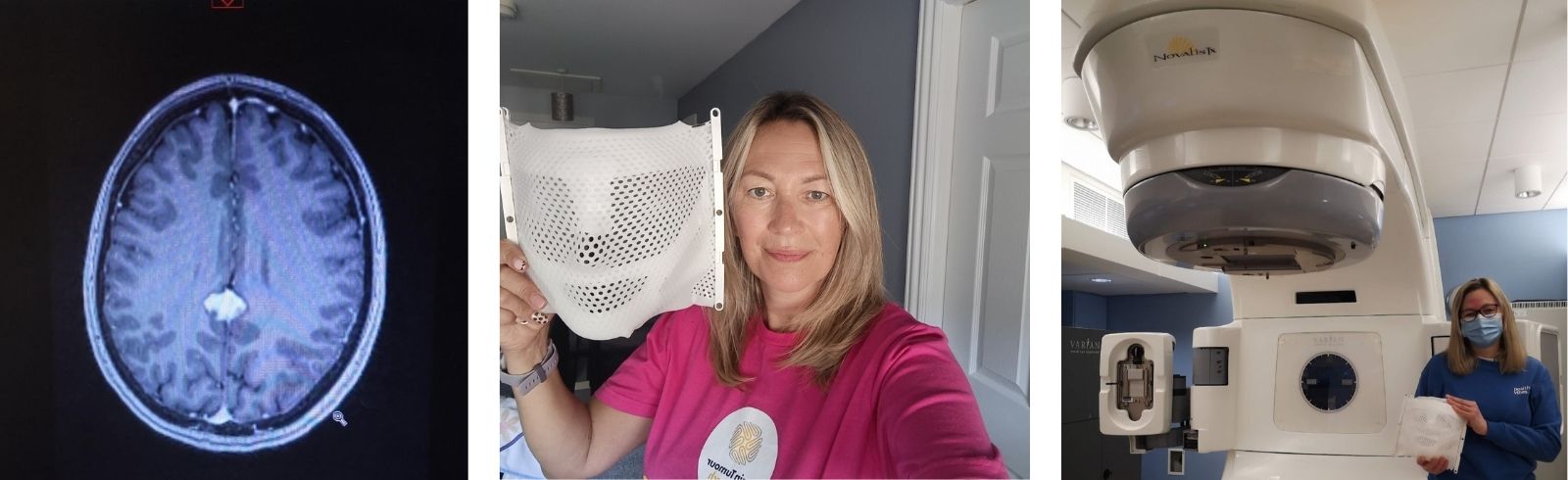
April Tait, 52, from Burntisland in Fife, was diagnosed with a brain tumour in 2018 after mistaking memory issues for menopause symptoms. Scans revealed a posterior falcine meningioma, deep in the centre of her brain and considered inoperable. In 2023, she underwent stereotactic radiotherapy and now has annual scans to monitor its growth. April continues working as a childminder and supports Brain Tumour Research by taking on fundraising challenges to raise awareness.

April tells her story…
I was 45 when it all started. It was 2018, and I was going through the menopause, so I thought everything I was feeling was just part of that. But then one day, I was at school drop-off, chatting with some of the kids, and I suddenly couldn’t remember one of their names. It threw me.
That same day, I had a phone call from my GP to check in about my menopause symptoms, and I just happened to mention what had happened that morning. She told me to come into the surgery right away. I thought it’d be a quick check-up, but she was concerned. Stroke was mentioned, and that’s when the panic really started.
My mum stayed with the children I was minding while I went to the local Victoria Hospital. A scan showed what they described as a “small dot” on my brain. They didn’t know if it was a stroke, a blood clot, or something else, so I was admitted for further tests. Eventually, I was told I had a mass on my brain – possibly a tumour – and I’d need to see a consultant at the Western General in Edinburgh.
When they said brain tumour, my first thought was that I was going to die.
It was a numbing moment. I was a single mum, and my daughter Abbie was still a teenager. All I could think about was not being there for her.
After more scans, the diagnosis came back: I had a posterior falcine meningioma, a low-grade brain tumour found at the back of the brain. It was non-cancerous, but it was in a part of the brain they couldn’t operate on due to the severe risks. The surgeon told me he’d only attempted surgery in that area once before. So, I was placed on watch and wait, with regular six-monthly scans to keep an eye on it.
At first, it was terrifying. Not knowing if it would grow or how fast. I had to take time off work – I’ve been a childminder for 14 years and I love it, but I needed time to come to terms with what this meant. Would I still be able to do my job? Would parents trust me with their children? Thankfully, I had a brilliant support network of my family, my friends, and most importantly, Abbie.
Over time, I began to adjust. The tumour was slow-growing, and for a while, it didn’t change much.

By late 2022, the doctors noticed growth and suggested stereotactic radiotherapy to stop it from getting worse.
As it was still under 30mm in size, I qualified for the less invasive type of radiotherapy. It wasn’t an easy decision because the long-term effects of radiotherapy scared me. But eventually, I agreed. In March 2023, I had a full week of treatment. Before that, they made a custom mask to hold my head still – it was claustrophobic, and it took two tries to get it right, but the staff were amazing and made me feel at ease.
Each day, I’d lie down, my mask would be fixed in place, and I’d listen to music while the machine worked. The treatment only took about 20 minutes each time, but it was emotionally draining. At the end of the week, I was exhausted and nervous. Now came the wait to find out if it had worked.
When I had my scan a few weeks later, the consultant told me the radiotherapy had worked, the tumour had shrunk.
I was so relieved. It’s since shrunk a bit more with each scan. My next one is due soon and I won’t lie, the anxiety never goes away. Scanxiety is real.
Being self-employed added another layer of stress. When I had to take time off during treatment, I worried about how I would manage financially. There wasn’t much support, and that pressure made everything even harder to cope with.
It has affected other parts of my life too. When I met my new partner, I was scared to tell him about my diagnosis. I was worried it might put him off. I didn’t want to burden anyone with what I was going through. I had learned to live with it, and I didn’t want someone else to feel they had to as well. But I’ve come to understand that those feelings are probably normal. There are likely others out there thinking the same, and I hope they can see that we still deserve to live fully and to love and be loved too.

But I’m doing well and running again. I joined the Kirkcaldy Wizards running club and even completed a 5k. I’ve got an inflatable fun run lined up with my best friend Kerry, who’s been by my side through everything. She's been my rock.
I don’t talk about my diagnosis much, a lot of people around me don’t even know. But that’s changing. I’ve taken part in fundraisers for Brain Tumour Research before – like the 200k in May Your Way and Mr Motivator’s challenge – and now I’m doing the 88 squats a day in July challenge too.
It’s not just about raising money – although every penny helps – it’s about raising awareness.
People hear ‘benign’ or ‘low-grade’ and think you’re fine, but that’s not how it works. I still live with this brain tumour every day. It’s still there, it still affects what I can do, and I have to keep checking it hasn’t grown.
I want more people to understand what living with a brain tumour is really like and I want more funding for this cause. Just 1% of the national spend on cancer research has been allocated to brain tumours since records began in 2002. That needs to change. We need more options, better treatments, and earlier diagnoses.

If I can help raise awareness and support research – even just a little – then that gives all of this some purpose.
April Tait
July 2025
One in three people in the UK knows someone affected by a brain tumour. This disease is indiscriminate; it can affect anyone at any age. What’s more, brain tumours continue to kill more children and adults under the age of 40 than any other cancer yet, to date, just 1% of the national spend on cancer research has been allocated to this devastating disease since records began in 2002.
Brain Tumour Research is determined to change this.
If you have been inspired by April’s story, you may like to make a donation via www.braintumourresearch.org/donate or leave a gift in your will via www.braintumourresearch.org/legacy
Together we will find a cure.
