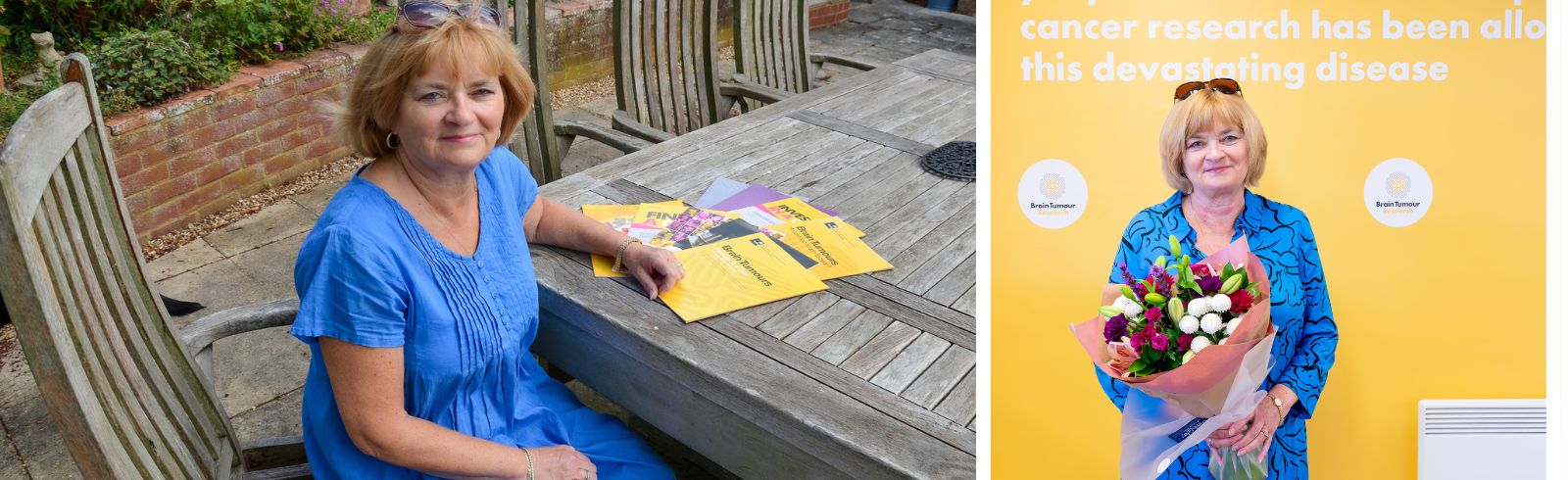
It was with great sadness that I decided to retire as a Trustee and Vice Chair of Brain Tumour Research, having retired as Chief Executive on 30th June 2023. My retirement as Chief Executive came much earlier than expected due to being diagnosed with low-grade abdominal cancer and having had major surgery to treat it in September 2022. After my ‘recovery’, it quickly became apparent that I was no longer strong enough to commit the levels of energy I wanted or needed to deliver. I thoroughly enjoyed my time both founding and growing the charity; they were incredibly fulfilling years.
First and foremost, I will remain steadfast in celebrating the life of my beloved niece Alison Phelan (pictured below), in less than eight years, she left such a mark on my heart and the hearts of the rest of my family that she inspired a movement.

In August 2000, after three months of trips to doctors, opticians and A&E with their little girl, my sister Julie and her husband Gary were given the devastating news that Ali had a brain tumour, a brain stem glioma (now often known as a DIPG). “There’s nothing we can do – the tumour is untreatable.”
As a family, we all rallied round and tried everything we could to stop the inevitable. We went on a journey of discovery and were shocked and horrified at how little money went into research to discover the causes of and treatments for this devastating disease.
Gary and I met brain tumour researcher Professor Geoff Pilkington, who revealed that brain tumours were then the third biggest killer of children, after accidents and leukaemia, and there were fewer than 10 UK brain tumour charities. Moreover, less than £1 million per year was being invested in research into brain tumours and there were no dedicated research centres.
We lost Ali just 10 months later, in June 2001, three weeks before her eighth birthday. I have never felt so helpless.

Julie and Gary (pictured above with Sue at an event at Speaker's House) decided they wanted to set up a charity called Ali’s Dream and to announce their intention at Ali’s funeral. United in grief, Ali’s family and friends were determined to do something so that a cure could be found sooner rather than later and to stop other families suffering the same. Ali’s Dream became a frenzy of activity, taking over all our lives and has raised more than £1 million to date.
Thanks to initial introductions from Prof Pilkington, Gary and I developed relationships with other brain tumour charities during conferences. At a workshop in 2003, we started to build a vision and a plan for what needed to be done nationally to better support patients and their families, advance treatments and find a cure.
In January 2004, I met with my local MP, John Bercow, at his weekly surgery. Ali’s story inspired him to get behind us and lead the first-ever debate on brain tumours in the House of Commons. In 2005, with the support of Ali’s Dream, John was instrumental in setting up the All-Party Parliamentary Group on Brain Tumours (APPGBT) for which Brain Tumour Research now holds the secretariat.
By 2007, there was still no national presence among the UK brain tumour charities and no one charity was raising more than £200,000 a year. The national spend on research into brain tumours was then just £2.3 million, compared with £26 million for leukaemia and £32.9 million for breast cancer. Both these latter forms of cancer have since enjoyed massive improvements in survival rates, with leukaemia reversing its 20% five-year survival to 80%.
Over a couple of years, I met several times with Sandy Saunders of The Diana Ford Trust and Wendy Fulcher from Brain Tumour Research Campaign (BTRC). We decided we needed to formalise our relationship and create a national charity which Sandy wanted to back with the reserves of The Diana Ford Trust.

With the support of my husband, Justin (pictured above), I devoted my time pro bono to setting up the charity, in the first instance, using the infrastructure of my marketing business, Believe. The Diana Ford Trust changed its name to Brain Tumour Research in 2008. Except for Sandy, their Trustees stepped down with Wendy and I becoming trustees along with other founding trustees: Nigel Boutwood from Charlie’s Challenge, Helen Bulbeck of brainstrust, Tina Mitchell (now Mitchell Skinner) from Hammer Out (now Brain Tumour Support) and Carol Robertson of Andrea’s Gift (now Yorkshire’s Brain Tumour Charity). In April 2009, Brain Tumour Research was launched at the House of Commons with all 14 founding Member Charities in attendance.
A year later, in collaboration with Ali’s Dream and Charlie’s Challenge, Brain Tumour Research opened the first Centre of Excellence at the University of Portsmouth, which we funded for nine years.
By 2013, Brain Tumour Research was raising more than £1 million per year, leading to the establishment of Centres of Excellence at Queen Mary University of London, the University of Plymouth and, in collaboration with BTRC, Imperial College London.
Along with setting up a portfolio of Research Centres, I was determined to influence the Government to increase its investment in research into brain tumours and am proud of the work we did with PB Consulting, including developing our first statistics report on National Research Funding in 2013 and first pre-general election Manifesto – Invest in a Cure. Launched in March 2015, we demanded an increase in national investment in research into brain tumours to £30-35 million a year, in line with other cancers.
Our further game-changing campaigning achievements have included the August 2015 e-petition in collaboration with Maria Lester and her parents, Peter and Liz Realf, marking the first anniversary of the loss of Stephen Realf. It attracted more than 120,000 signatures, was the subject of the Petitions Committee’s first-ever report, and led to the establishment of the Government Task and Finish Group on brain tumour research.
We launched a further report in 2016 Addressing the historic underfunding of brain tumour research and, under the chairmanship of Derek Thomas MP, we led two APPGBT Inquiries and resulting reports – A cost too much to bear in 2018 and Pathway to a Cure in 2023, which I co-authored. This led to the first-ever business debate on brain tumours in the House of Commons.
My proudest moment came in November 2016 when I received a letter from Buckingham Palace, informing me that I was to be made an MBE in the 2017 New Year’s Honours list for services to brain tumour research and awareness-raising. I was privileged and honoured that Her Majesty Queen Elizabeth II presided over my investiture. Thank you so much to everyone who helped me – I didn’t do this alone!

There are too many people to name, but hopefully you know who you are – including loyal employees of the Charity and dedicated supporters and fundraisers who have helped us through both the exciting times and the stressful. The pandemic was a particularly difficult time for our Charity, as it was for so many charities. However, with the help of our faithful supporters, we bucked the trend, including as an early adopter of the Facebook challenge concept, in 2021, raising nearly £1 million with our first 10,000 Steps a Day challenge.
I continue to be in awe of our committed researchers, focused on finding cures for all types of tumours. Their research has been of the highest quality, under the watchful eye of our Scientific and Medical Advisory Board, working on more personalised treatments for patients; repurposing existing drugs to increase options; identifying the mutations in low-grade brain tumours that accelerate tumour growth; improving the diagnostic and treatment pathway; finding ways of delivering drugs across the blood-brain barrier; and testing ways to starve tumour cells of the energy they need to grow and expand – to name but a few!
When I announced my retirement in 2023, I was overwhelmed by the many lovely messages I received and continue to receive. Brain Tumour Research had become a truly national charity, it had raised £43 million, established five pioneering Centres of Excellence, was funding three research infrastructure initiatives, raised awareness beyond our dreams, built and led a highly successful APPGBT and become the leading voice of the brain tumour community in Parliament, across social media channels and through national, regional and online media. What’s more, the national investment in research into brain tumours had increased to £15 million a year, compared to less than £1 million when we lost Ali.

Stepping down now from my position of Vice Chair of the Board of Trustees to become an Ambassador, I’m taking the opportunity to look after myself and dedicate my time more fully to my other passions – my family (pictured above) and my church. However, I remain committed to the Charity, our vision to find a cure for all types of brain tumours and our mission to increase the national investment in research into brain tumours to bring parity with other cancers.
My passion will not wane – I will always be a co-founder – and will continue to support the next era of the Charity’s growth as an Ambassador and activist. Meanwhile, I will refer my network to Brain Tumour Research, attend events, fundraise and donate.
I will never forget the dedication and commitment of my fellow founders, the reasons we set up the charity and the legacy we have created. Brain Tumour Research represents a legacy in memory of Alison Phelan (Ali), Diana Ford and John Fulcher, as well as for the bravery of Charlie Boutwood and all those we have met along the way. Memories that will live on in the heart of the Charity.
If you would like to make a donation to my retirement fundraising – I’m aiming to sponsor more days of research at each of our Centres of Excellence – please go to www.justgiving.com/page/sue-farrington-smith-1682453902610. Thank you.
Together we will find a cure
