
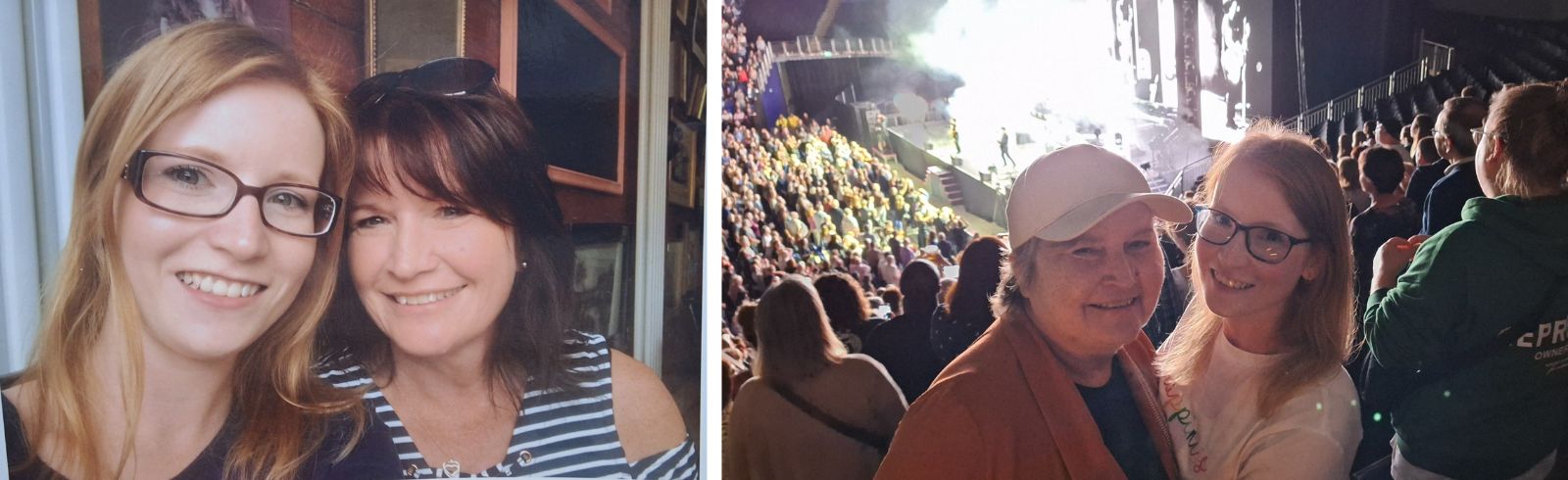
Jackie, from Kent, died of a glioblastoma in April 2025 aged 58, more than two years after a seizure led to her diagnosis. Despite radiotherapy and chemotherapy, she developed a second tumour in March 2024, and treatment was ineffective. Her daughter Abrica, now 34, was diagnosed with a grade 4 medulloblastoma more than 20 years ago, with doctors confirming there is no genetic link. Abrica shares her mum’s story and emphasises that the need for research into brain tumours is greater than ever.

Here is Jackie’s story, as told by her daughter, Abrica…
There were no signs of the disease before Mum was diagnosed with a brain tumour in November 2022, after she had a second seizure. The first had happened two months earlier, completely out of the blue.
It was early September, in the morning, when Mum came into the room where I was and dropped herself onto the bed. She said she had pain in her head and shoulder and kept repeating the word “pain.” Two minutes later, her body went into a tonic-clonic seizure. I called an ambulance, and, at the same time, her arms shot out in front of her as if something had taken over her body. It was frightening and surreal to watch.

She was taken to King’s College Hospital in West London. Mum had Behçet's disease, a rare, chronic inflammatory disorder that affects multiple parts of the body. She also had fibromyalgia which caused ulcers in her mouth and throughout her body which must have been painful.
Unsure if the disease had spread, the medical team did a MRI scan and saw a tumour on her brain which after more investigation was diagnosed as a glioblastoma.
I was forced to reminisce of my own diagnosis of a stage 4 medulloblastoma in 2004 when I was 13. I had surgery and was placed in an induced coma. After radiotherapy and chemotherapy, I was discharged from treatment at 18 and now live a normal life.
I asked, but doctors said there is no genetic link with me and my mum.
I remember the video call in which the nurse gave us the news of Mum’s diagnosis and told us her type of tumour was incurable.
I’d seen people in the Facebook groups I’m part of talk about different tumour types and had always thought, if anyone I know gets a brain tumour, please don’t let it be a glioblastoma. When I heard that word, I went numb and grabbed my mum, pulling her in for a tight hug. Although I was sure she didn’t know what it meant, I did.
Me and Mum were really close. I could see she was trying to hold onto her emotions.

Now, my mum was having to go through a brain tumour diagnosis again, this time her own. I was a teenager when I was diagnosed and old enough to recognise how much she did for me. I made the decision that I would be there for her; I wanted to repay my mum for her love and support when I was going through my diagnosis.
Mum’s tumour was in a location that made surgery to remove it impossible.
She responded well to radiotherapy and chemotherapy which shrunk it from being the shape of a satsuma to the size of a tiny dot. From November 2023 to March 2024, Mum was stable, and I took part in a Jump For Hope to raise money for Brain Tumour Research to help people like me and my mum.
In March 2024 a routine scan showed a second brain tumour had started to grow and there was a build-up of fluid which was life threatening. We were told that, without surgery to drain the fluid, Mum could die within three months as opposed to 10 months with the procedure.

She struggled with the decision but opted for the operation which caused a bleed on her brain, luckily the blood drained to the pocket space which had been emptied of fluid, and she recovered well. She had two more months of radiotherapy which wasn’t having any impact on the tumour and all treatment was stopped.
We’d run out of treatment options.
From October 2024 we lived everyday as it came. By March 2025 Mum had a few falls and was admitted to Darent Valley Hospital in Dartford and never came home. She died on 12 April 2025.

For Mum’s funeral, people donated to Brain Tumour Research, and it remains a cause very important to me. At the end of 2023, shortly after Mum was diagnosed with the disease, we both visited the Brain Tumour Research Centre of Excellence at Queen Mary University London. Getting to place two tiles on the Wall of Hope together and seeing first-hand how the money was being put to work to try and solve the health inequality crisis was inspiring.

One in three people knows someone affected by a brain tumour but talking to people, they still don’t know brain tumours and that brain cancer exists. I want to raise awareness of brain tumours and the lack of investment in research into the disease so that more people feel motivated to join the community and help fund the fight.
Jackie Bennett
August 2025
One in three people in the UK knows someone affected by a brain tumour. This disease is indiscriminate; it can affect anyone at any age. What’s more, brain tumours continue to kill more children and adults under the age of 40 than any other cancer yet, to date, just 1% of the national spend on cancer research has been allocated to this devastating disease since records began in 2002.
Brain Tumour Research is determined to change this.
If you have been touched by Jackie’s story, you may like to make a donation via www.braintumourresearch.org/donate or leave a gift in your will via www.braintumourresearch.org/legacy
Together we will find a cure.
