
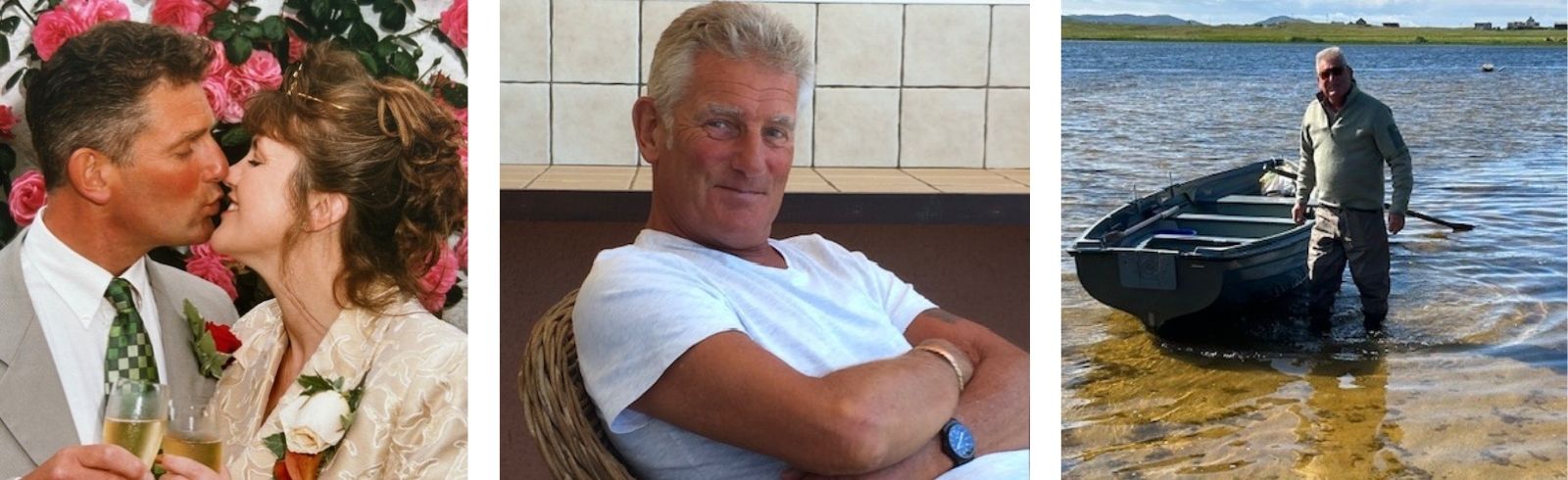
Andy Macfarlane, a gentle and nature-loving man from Linlithgow in Scotland, was diagnosed with a glioblastoma in December 2022 after experiencing subtle but worrying changes in his behaviour and memory while on holiday with his wife, Joanne. The aggressive and cancerous tumour was confirmed following emergency scans, and Andy was given a prognosis of 12 to 18 months. He underwent brain surgery and radiotherapy, but his condition gradually worsened. Andy died peacefully on 1 July 2024, aged 72 – just one day before what would have been his and Joanne’s 25th wedding anniversary.

Here is Andy’s story, as told by his wife, Joanne…
Andy was the love of my life. He was a quiet, kind, loving and supportive husband, full of humour and young at heart. He had a deep love of the natural world and trained as an ecologist, town planner and landscape scientist. We met through work in 1992 and had an instant connection. I moved to Scotland in 1995 and had been together ever since. We built a life together in Linlithgow, and shared a passion for countryside sports, walking, gardening, and growing our own food.
Andy was a true countryman, a keen fisherman, wildfowler and good shot who fully appreciated the need for countryside management whilst being sensitive to the natural world, its beauty, and fragility.
It was during Christmas 2022, while we were in Fuerteventura, that I first knew something was wrong.
Andy seemed a little off – quieter than usual and slightly muddled. At first, I thought he was just tired, but then he started struggling with everyday tasks, like folding a beach blanket or setting the table. He’d get frustrated, and there were flashes of uncharacteristic anger. He started bumping into things on his right-hand side, and one day asked me to drive – something he almost never did. I was starting to get concerned.

We sat down together one morning and made a list of everything we’d noticed. We filled a page. That’s when I phoned our GP back in Scotland who told us to get on the next flight home. I found a doctor in Fuerteventura who did a physical assessment, confirmed her concerns, and urged us to travel immediately.
We flew home on 29 December. By then, Andy was extremely confused – he couldn’t follow basic instructions at airport security. I took him straight to our GP the next morning. She referred him for a scan at St John’s Hospital in Livingston.
That evening, the hospital called and said they’d found a brain tumour.
I was in shock. When I went to the hospital, I was told they’d started him on steroids to reduce the swelling around the tumour which was causing many of the symptoms. There was no explanation beyond that, and I remember thinking: what happens now?
Andy stabilised quickly on the steroids. Within a few days, it was like he was back to himself. We were hopeful. In February 2023, he underwent brain surgery at Edinburgh Royal Infirmary. His surgeon warned us it wouldn’t be possible to remove the entire tumour due to its location, and that they would do a biopsy to confirm the type.
A few days later, the oncologist told us it was a glioblastoma. We’d never heard the term before so she explained that it was aggressive, incurable, and Andy would likely have 12 to 18 months. He simply said, “Alright then, I’ll go for 18.”

He never once said “why me?” He accepted it with grace. He was more upset about others – young people, especially – who were being diagnosed. I remember him crying when he read about Theo Burrell, the Antiques Roadshow expert with the same diagnosis. He said, “At least I’ve had my life. She’s young and has a family.”
Andy began radiotherapy at the Edinburgh Western General Hospital – five days a week for six weeks. A friend warned me how exhausting the travel would be, and she was right. I gathered a team of friends and created a rota. I did Mondays and Fridays, and our amazing friends took turns on the other days. It gave Andy different company and gave me a bit of rest.
For a while, he did well and the scans showed the tumour was stable. But glioblastoma has a cruel way of giving false hope.
By spring 2024, Andy was struggling with mobility. He was bloated from the steroids, tired, and having small seizures. In April 2024, we returned to Fuerteventura for my birthday. We had a beautiful gathering with friends, but it felt like a farewell. He was slower and more withdrawn, but still himself. Still trying.
When we got back, his decline accelerated. He became confused at night, couldn’t find the toilet, and at times didn’t recognise where he was. He would sit on the bed looking out at the stars, saying “What’s the point?” I was trying to care for him alone, but it was overwhelming. He had various infections and remained on high doses of steroids, which weakened his skin terribly.
Eventually, we had to call in professional carers. Sometimes he’d be himself, friendly and chatty. Other times, he’d swear at them, confused, disoriented and afraid.
In late June 2024, his condition deteriorated rapidly. I took him back to hospital, where the palliative care team assessed him. He was distressed, angry, and constantly moving. The hospital team transferred him to a small palliative care unit in Armadale where he had his own room where we could be together and friends and family could visit. They were so caring and they kept him calm and comfortable.

He was only there for four days. On the last day, I got very upset. He saw me crying and, with a tenderness I hadn’t seen in weeks, reached out and gently stroked my arm.
That’s when I knew: he’s still in there.
That night, I stayed with him. I sat by his bed, held his hand, and watched his breathing slow. The nurses joined me.
It was 1 July 2024, the day before our 25th wedding anniversary, when Andy slipped away peacefully.
Since Andy’s death, I’ve raised over £5,750 for Brain Tumour Research, a wonderful charity that’s close to my heart. I switched all my birthday and Christmas fundraisers to support them and set up a small monthly donation to the memorial page I set up, which helps me to keep his memory (and the fund) alive. This year, I took part in 200k In May Your Way. I walked, swam and sketched – one drawing equalling 2.3 kilometres. Friends took to requesting sketches more than tracking my mileage! But I don’t mind. It keeps me occupied, creative, and connected to Andy.
What I find unforgivable is how little is still known about brain tumours. How can something that kills more children and adults under 40 than any other cancer still receive just 1% of the national spend on research?
Andy and I asked so many questions about where it came from but the neurosurgeon could only say, we don’t know. That’s not good enough. It’s why I’m campaigning now – writing to MPs, raising awareness, and doing all I can to support this cause in finding a cure.

To anyone facing this diagnosis I would say: stay positive and just 'be together'. Do the small things. Sit in the garden. Watch the birds. Laugh when you can. Cry when you need to. Don’t wait for special occasions – make every day special.
Andy didn’t have a bucket list. He said he had done everything he ever wanted to do and was already happy and that’s what we focused on: living the life we already loved.
I love him and miss him every second of every minute of every day, and I always will.
Joanne Macfarlane
August 2025
One in three people in the UK knows someone affected by a brain tumour. This disease is indiscriminate; it can affect anyone at any age. What’s more, brain tumours continue to kill more children and adults under the age of 40 than any other cancer yet, to date, just 1% of the national spend on cancer research has been allocated to this devastating disease since records began in 2002.
Brain Tumour Research is determined to change this.
If you have been touched by Andy’s story, you may like to make a donation via www.braintumourresearch.org/donate or leave a gift in your will via www.braintumourresearch.org/legacy
Together we will find a cure.
