
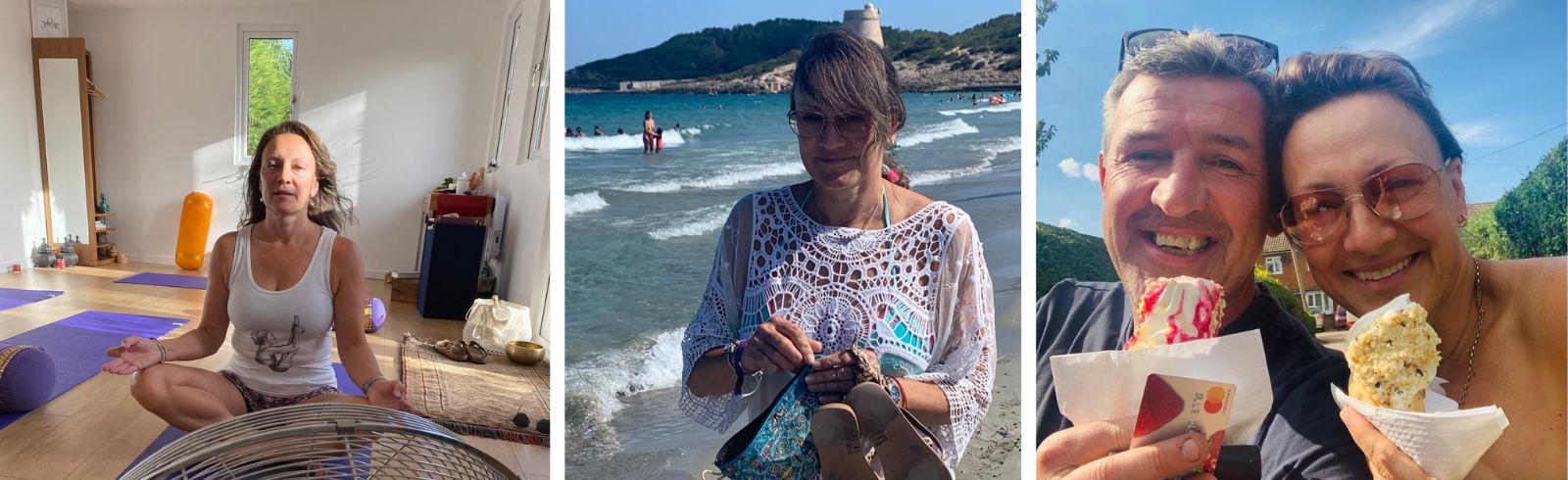
Teaching assistant and yoga teacher Annalisa, from Bedfordshire, was diagnosed with a glioblastoma in March 2025 after suffering a seizure out of the blue. Following an operation to debulk the tumour, the 58-year-old had combined radiotherapy and chemotherapy treatment. Annalisa is one of 100 people in the UK waiting to start a clinical trial for glioblastoma patients and is sharing her story to raise awareness of the health inequalities brain tumour patients face.

Annalisa tells her story…
Alongside colleagues from Arnold Academy, where I worked as a special educational needs teaching assistant, we set off by car from Bedfordshire to the Brecon Beacons National Park in Wales. We were heading there for a 16KM hike in aid of Brain Tumour Research at the end of March 2025, in memory of George Fox, a teenage boy who died from a glioblastoma in 2022.
For most of the journey, I felt sick and ended up sleeping almost the entire way which was unusual for me, as I’m normally active and on the go. Outside of my work at the school, I’d been teaching yoga part-time since 2020.

When we reached the hotel, during check-in, my boss, who I was sharing a room with, saw me leaning against a wall. I could see she was talking to me, but I couldn’t physically speak to respond. I don’t remember what happened next, but I’m told that she walked us to the room where I stood myself in the corner. My shoulder began to twitch, and my foot turned out to the side, as I was about to collapse, my boss caught me and broke my fall. She managed to hold the door to the room open with her foot and called for help.
My first memory after collapsing was waking up in a local hospital, confused. I was able to speak but didn’t know why I was there.
An MRI scan found I had a brain tumour, initially thought to be a glioma. News I had a brain tumour felt like a huge surprise. I was shocked.
I knew George had a glioblastoma, so when they said mine was a glioma, I thought to myself that it could be a lot worse.
I was transferred to Addenbrooke’s in Cambridge who told me to forget what I’d been told and they confirmed my brain tumour was a stage 4 glioblastoma. I was devastated. Having seen the little boy in our village go through his diagnosis, I knew what that could mean for me.
Straight away I thought of my children. I lost my mum to cancer just before I turned 30. My eldest son, Kane, is nearly 30 and hearing my diagnosis brought back lots of feelings and emotions.

I was placed on anti-seizure medication and given morphine for the pain in my head which was excruciating. Eventually the morphine stopped working and I was crying in discomfort on the ward until multiple doctors signed off a higher dose. Even the patient in the bed next to mine was in tears at my screams.
I was nervous for the debulking surgery which took place on 16 May. Doctors removed 90% of the tumour, which left me feeling extremely tired and wanting to sleep.

Our family has turned to counselling to support us through this time and Kane has taken on the role of my carer; doing the cooking and gardening, things I would normally do but unable to now, all whilst my husband, John, is going to work.

I’ve now completed combined radiotherapy and chemotherapy treatment which came with side effects of dizziness, fatigue and forgetfulness.
After my operation, my oncologist at Addenbrooke’s, Dr Marieke Thompson, mentioned a clinical trial that was about to begin. She left the room to gather more details and returned to tell me about EF-41, a trial taking place in the UK and around the world. It uses Optune®, a treatment for glioblastoma patients, alongside oral chemotherapy (temozolomide) and intravenous immunotherapy (pembrolizumab).
Dr Thompson explained what it would involve. I’ll wear a cap fitted to my scalp, which means shaving my head three times a week so the electrical impulses could reach the tumour cells properly which might leave my skin sore or tender. The device sends electric impulses, called Tumour Treating Fields (TTF), to the tumour cells to stop them from dividing and multiplying. It’s portable, and I’ll be wearing it for up to 20 hours a day. Right now, no one knows how long I’ll need it – it could be weeks, could be months – but I’ll be closely monitored with regular MRI scans to track how I’m responding.
When Dr Thompson told me how much the treatment can cost outside of a trial – as much as £20,000 a month – I was stunned. I honestly don’t know how I would have afforded it otherwise, or how anyone does. I felt incredibly lucky to be included in the trial, and it felt like it was about being in the right place at the right time. Access to treatment shouldn’t come down to luck. It’s a stark reminder that we’re not all starting from the same place when it comes to healthcare.
Since my diagnosis, I’ve formed a bond with George’s mum, Lou. They travelled to the USA hoping George could start a different clinical trial in 2022, one that ended up costing them hundreds of thousands of dollars. But sadly, George became too unwell to begin treatment.
Being diagnosed with a life-limiting brain tumour feels desperately unfair. But the truth is, life is unfair. No doctor can say why this happened to me.
Brain tumours are indiscriminate, they can affect anyone at any age. And the fight for treatment often mirrors that same randomness and inequality.

John and Kane are currently taking part in Cycle 274 Miles in August to give something back and support Brain Tumour Research whose campaigning and drive for more investment in research into the disease has brought us some comfort. It helps to know that progress is being made and that, in their own way, they’re part of something bigger, a movement that’s pushing for change.
Annalisa McKenna
August 2025
One in three people in the UK knows someone affected by a brain tumour. This disease is indiscriminate; it can affect anyone at any age. What’s more, brain tumours continue to kill more children and adults under the age of 40 than any other cancer yet, to date, just 1% of the national spend on cancer research has been allocated to this devastating disease since records began in 2002.
Brain Tumour Research is determined to change this.
If you have been inspired by Annalisa’s story, you may like to make a donation via www.braintumourresearch.org/donate or leave a gift in your will via www.braintumourresearch.org/legacy
Together we will find a cure.
