
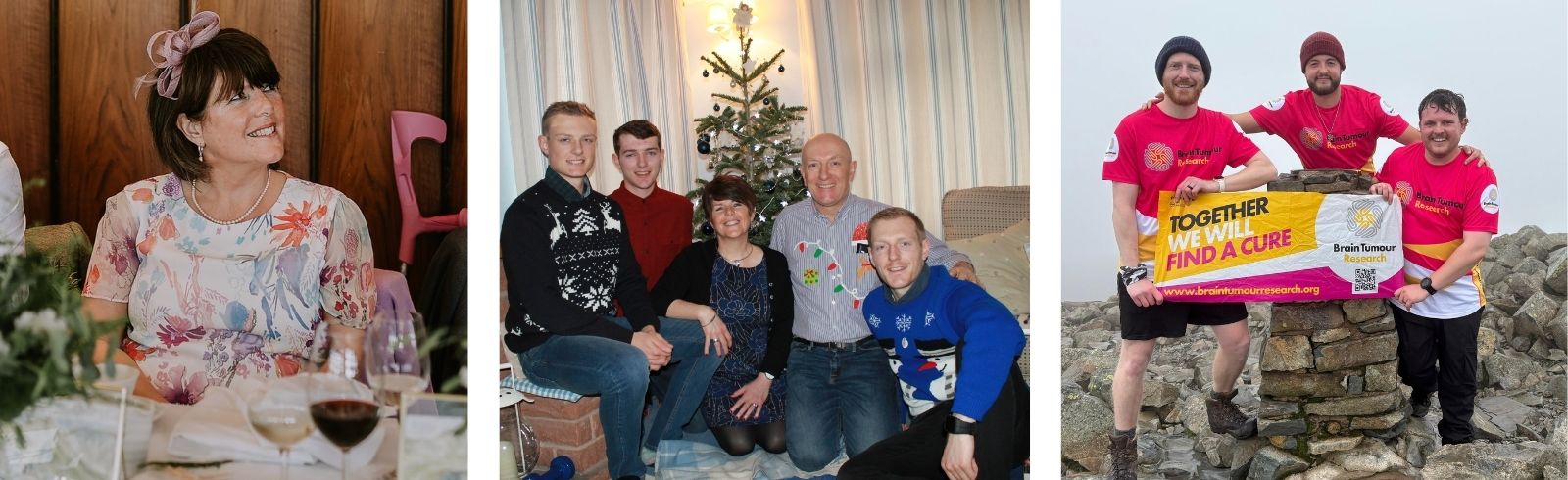
Fiona Sim, a devoted mother-of-three and health visitor from Penrith in Cumbria, was diagnosed with a glioblastoma on her birthday in February 2023, following a sudden seizure at home the previous month. She underwent surgery, daily radiotherapy and chemotherapy, and even took part in a clinical trial to support research into the disease. Despite early signs of recovery – including attending one of her son’s weddings – her health declined rapidly by late summer. Fiona died on 25 October 2023, aged 59, just eight months after her diagnosis. Her family has since raised thousands for Brain Tumour Research, including through the National Thee Peaks Challenge.

Here is Fiona’s story, as told by her son, Jonny…
Mum was an incredibly warm, giving, and compassionate person. She worked for many years as a health visitor, supporting young families and new mothers throughout our local community in Cumbria. Her commitment to others wasn’t just part of her job, it was a core part of who she was. Whether she was helping to organise village events, founding an autism support group after my youngest brother was diagnosed with Asperger’s, or volunteering to house Ukrainian refugees, she never hesitated to step forward and help.
She was also the heart of our family. Mum raised me and my two brothers, Tom and Ed, with a strong sense of kindness and fairness, and a love for the outdoors that shaped much of our childhood. We spent countless days walking in the Lake District, exploring the Scottish Highlands, and making memories that would stay with us forever. She led from the front, quite literally, often marching ahead on our hikes while we tried to keep up.

Life changed dramatically in January 2023 when Mum had a seizure at home.
Thankfully my dad and youngest brother were with her but it must have been a terrifying experience. She was taken to Carlisle Hospital, where she underwent scans that revealed a tumour on her brain. She underwent a craniotomy on 7th February, and just a few weeks later, on 22 February, which happened to be her birthday, we received the diagnosis that Mum had a glioblastoma, an aggressive and incurable form of brain tumour.
We were shocked. None of us had been prepared for that kind of news. At first, we avoided searching for statistics or worst-case scenarios. We just wanted to focus on the next step and stay positive.
The tumour had affected a part of the brain linked to speech, which meant she needed language therapy afterwards. She knew what she wanted to say but sometimes struggled to find the words. It was frustrating for her, but she approached it with determination and grace.
She then began 30 days of daily radiotherapy and chemotherapy at the Freeman Hospital in Newcastle. Mum and Dad stayed in a flat near the hospital and spent nearly every day there during treatment. It was a tough time, but they faced it together.
Despite the seriousness of her condition, there were periods when she seemed to be making real progress.

In May, she was well enough to attend my brother Tom’s wedding.
She walked with us, took part in the ceremony, and shared in the celebration. That day meant everything to her and to us.
From the end of May, her treatment switched to chemotherapy tablets and ran in three week blocks, followed by a week off, and then another three week block of treatment. Mum and dad made the most of every week off and went away on several mini-breaks. They bought a little MG convertible, something they had talked about for years, and went on trips through the Lakes and along the Fife coast. It was their chance to reclaim a bit of freedom, and they truly cherished it.
Mum also took part in a clinical trial, which was testing whether a new drug could improve outcomes for people with glioblastoma. It involved taking a special drink every eight hours, including through the night. It wasn’t pleasant, but she stuck with it for as long as she could, knowing her involvement might one day help someone else. That’s the kind of person she was.
By the end of August, however, things started to change. Mum developed blood clots in her lungs and began to feel constantly exhausted. She had to stop the trial. In September, she was admitted to Eden Valley Hospice in Carlisle. By then, we all knew the direction things were heading.
My brothers and I moved back to be with her. Dad stayed at the hospice full-time. We visited every day. Those final weeks were incredibly hard, but they were also full of love. We still laughed together, still shared stories, and did our best to make those final weeks as full of comfort and care as possible.
Mum died peacefully on 25 October 2023, aged 59, just eight months after her diagnosis.
Since Mum’s passing, we’ve looked for ways to honour her memory and support the brain tumour cause. My dad walked the entire Hebridean Way, where he and Mum had spent their honeymoon. Tom ran seven ultra-marathons in seven days, from Edinburgh to the family home, while Ed took on the Edinburgh Half Marathon. I recently joined my friends Elliot and David to take on the National Three Peaks Challenge, climbing Snowdon, Scafell Pike, and Ben Nevis in three days.

The Three Peaks was tough. David injured his knee after the second climb and couldn’t finish, but Elliot and I carried on. At the summit of Ben Nevis, the clouds finally cleared and revealed a breathtaking view.
After days of walking through fog, it was a special moment. I stood there thinking of Mum and everything she had given us.
We’ve raised thousands of pounds for Brain Tumour Research, and we know that’s exactly what Mum would have wanted. Brain tumours kill more children and adults under 40 than any other cancer, yet just 1% of the UK’s national cancer research funding is allocated to this disease. That has to change.
We can’t go back, but we can do something. We can raise awareness, fund research, and fight for a better future for others facing this diagnosis. That’s what Mum would have done. That’s why we’re doing it too.
Jonny Sim
July 2025
One in three people in the UK knows someone affected by a brain tumour. This disease is indiscriminate; it can affect anyone at any age. What’s more, brain tumours continue to kill more children and adults under the age of 40 than any other cancer yet, to date, just 1% of the national spend on cancer research has been allocated to this devastating disease since records began in 2002.
Brain Tumour Research is determined to change this.
If you have been touched by Fiona’s story, you may like to make a donation via www.braintumourresearch.org/donate or leave a gift in your will via www.braintumourresearch.org/legacy
Together we will find a cure.
