
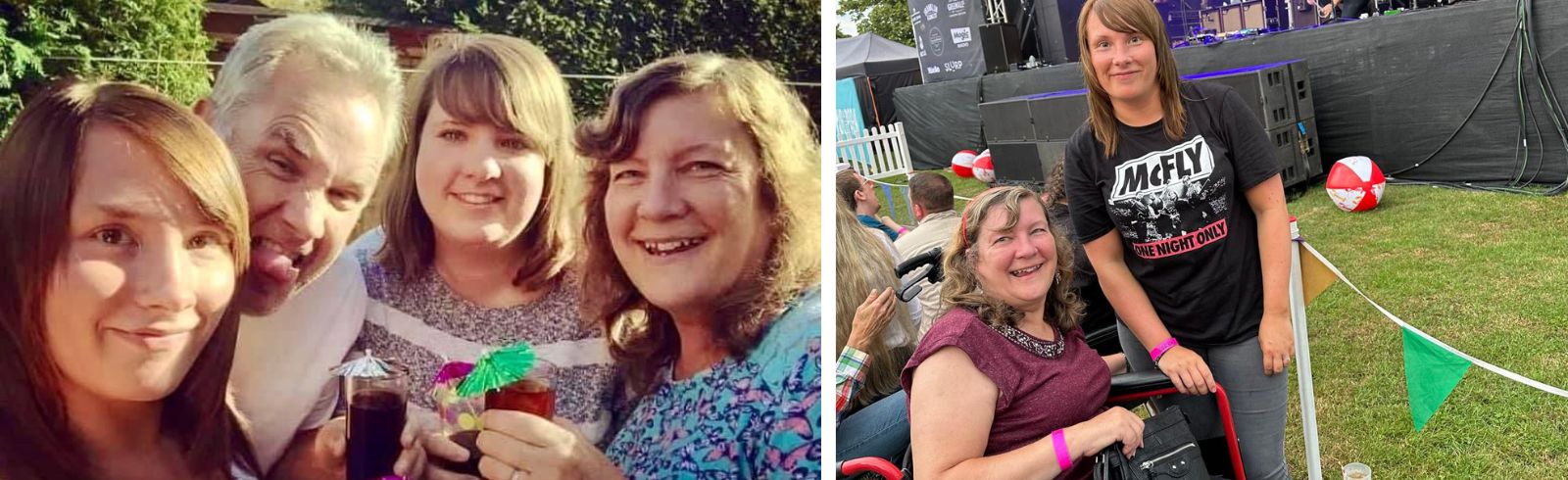
Susan, from Surrey, was diagnosed with a meningioma in May 2021 after experiencing weakness in her legs. The mum-of-two has since had surgery to remove the tumour and is monitored with regular scans. Now 63, side effects of her brain tumour diagnosis mean she uses a walker to get around and she struggles with balance. She is sharing her story to help shine a light on the lack of investment in research funding into the disease.

Susan tells her story…
My leg weakness began during the first lockdown in 2020. It was difficult to walk, and my balance was a bit off. It was gradual but enough for me to notice over time. In September of that year, I managed to get a GP appointment, and they gave me squat and lunge exercises to do to try and improve things. These didn’t seem to help and so they carried out tests on my lower body but couldn’t find anything that could be causing the issue and referred me for a full body MRI scan.
I went to the Spire Gatwick Park Hospital and was in the MRI scanner for 90 minutes. I’m not claustrophobic but being in the machine made me feel very enclosed. When I came out, I said to the staff that I never wanted to do that again. Little did I know, I would have to have many more due to my diagnosis.
The consultant delivered the results and explained I had a brain tumour.
They told me it was a meningioma, and this had been the reason for my balance issues.

I saw the golf-ball sized white blob on the scan image, it was at the back of my head, I was absolutely shocked by what I was hearing and seeing. Having a brain tumour was never on my radar, I thought perhaps it could be the signs of Multiple Sclerosis (MS) or Parkinson’s disease.
I never had any headaches so how it could be a brain tumour?
I struggled to take everything in, luckily, my husband of 41 years, Kevin, was with me. The consultant was amazing and explained everything to me. They said I could’ve been born with the tumour as it is slow-growing and not cancerous. Gradually, I began to process what was happening and over the weeks that followed, I knew I wanted the tumour out.
In July 2021, I had a seven-hour operation at St George’s Hospital in London, which removed the whole tumour. I felt a little nervous going into surgery but not as much as I thought. From my diagnosis to the tumour removal, everything was a quick process.
After getting over the fatigue and a week-long stay in hospital, I returned home. I knew there was no guarantee my walking would improve after the procedure, and I now use a walker to help me get around.
One of my biggest challenges is balance.
I had a fall in January 2023 and I’m currently working with a physio and going to a gym to help rehab my legs.

My routine scans now happen every two years and my next one is due in December. Because it’s slow-growing, I’ve been told that if the tumour recurs, it’s unlikely to be very big. Should that time come, there are treatment options such as radiotherapy, but as more time passes, the need is less likely.
I’ve since found out, meningioma is the most common form of adult primary brain tumour, and they account for approximately 30-37% of all adult central nervous system tumours. I was 59 when I was diagnosed and I’ve come to realise brain tumours are more common than people think and treatment hasn’t changed for years.

My daughter, Lindsay, took part in 200k in May Your Way and raised money for Brain Tumour Research. I was very proud of her for doing so and I think it’s something she’s kept up, even now.
Until something like this happens to you or your family, you don’t think about it.

I was in good health when I was diagnosed, it came completely out of the blue. I often think of popstar, Tom Parker, who was diagnosed with an aggressive tumour around the same time as me. He was young, famous, had his whole life ahead of him, but this disease doesn’t care who you are. Brain tumours are indiscriminate; they can affect anyone at any age. And now even Davina McCall has shared her diagnosis. It’s far more common than people realise, and yet research remains hugely underfunded.
Susan Rowlatt
August 2025
One in three people in the UK knows someone affected by a brain tumour. This disease is indiscriminate; it can affect anyone at any age. What’s more, brain tumours continue to kill more children and adults under the age of 40 than any other cancer yet, to date, just 1% of the national spend on cancer research has been allocated to this devastating disease since records began in 2002.
Brain Tumour Research is determined to change this.
If you have been touched by Susan’s story, you may like to make a donation via www.braintumourresearch.org/donate or leave a gift in your will via www.braintumourresearch.org/legacy
Together we will find a cure.
