
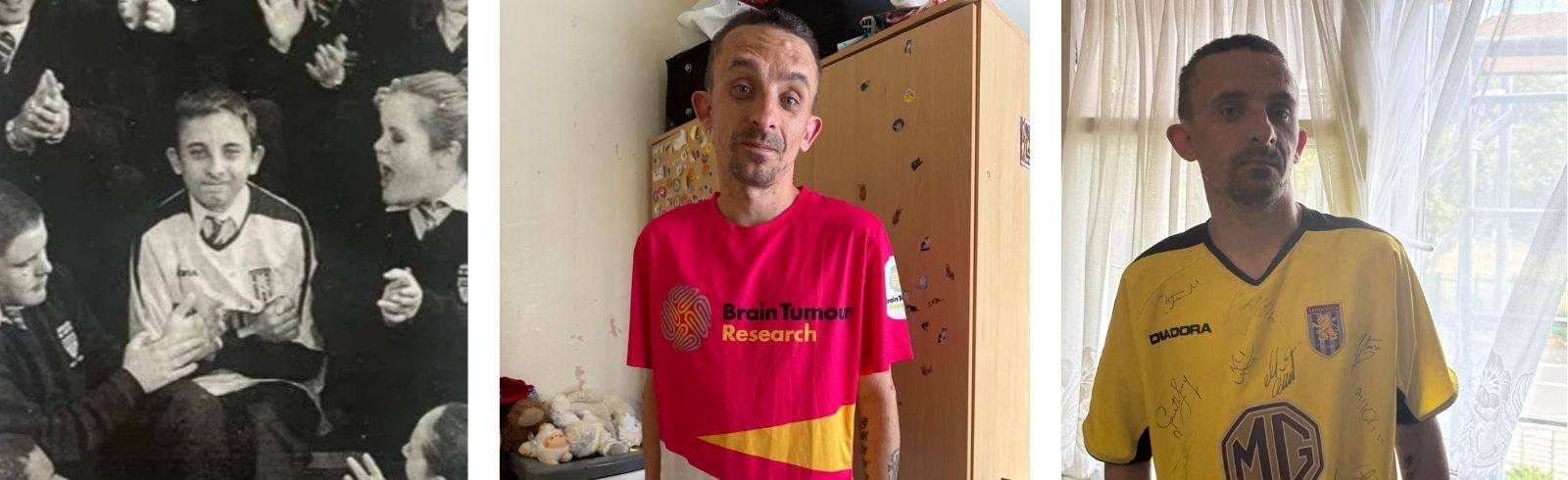
Jamie, from Birmingham, was diagnosed with an astrocytoma after having a full tonic- clonic seizure at home during his GCSEs when he was 16. Over the past two decades, Jamie has undergone three operations to remove four tumours, with regular MRI scans monitoring his condition.
Now 36, Jamie is gearing up for a daring challenge at Tottenham Hotspur Stadium, taking on the Dare Skywalk and a 46-metre rooftop descent, to raise vital funds and awareness for Brain Tumour Research.

Jamie tells his story…
I was just a normal teenager, gaming on my PlayStation, when my life changed completely.
It was June 2004, and I was in the middle of my GCSEs. I suddenly passed out and had a full tonic-clonic seizure.
I’d been having headaches before, but I put them down to exam stress. I had no idea anything more serious was going on. I woke up in Birmingham Children’s Hospital with my parents and doctors standing over me, looking worried.
I was totally confused and thinking "What on earth is going on?"

The last thing I remember was playing my PlayStation. Then I woke up in hospital and was being told I’d had a seizure. Doctors did a CT and MRI scan and found I had a brain tumour, an astrocytoma.
I was told it wasn’t cancerous, but that the surgery would be invasive and came with big risks. Doctors said I could lose my speech, sight, hearing, including my mobility and sense of taste.
I was shocked and scared, everything was like a whirlwind. Things moved so quickly.
Four days later I had brain surgery at Birmingham Children's Hospital. They managed to remove 84% of the tumour, some of it was too close to my central nervous system to safely extract. The surgery was successful and there was no impact on my mobility or vision which was a relief.
Thankfully, I recovered really well with rest, sleep, and gentle exercise. I even made it back to school before the end of term to finish my GCSEs.
After my surgery the doctors were pleased and said I didn’t need treatment, just regular three-monthly scans to monitor the remaining cells of the tumour.
I thought that might be the end this horror story. But during one of my routine scans, they found two more tumours. It was a big shock.
I couldn't believe it and didn't understand why two more tumours had grown. I remained positive and thought, let’s just get on with it and get them out.
In August 2005, I went back to Birmingham Children's Hospital for my second operation. I was nervous, but I trusted the surgeons. They managed to remove both new tumours, and they also got the remaining cells from my original tumour which had moved, making it safe to remove. Life was normal for a while, and I focused on recovery.
But then in 2012, during another routine scan, a new tumour was found. I remember thinking, "Here we go again".
I felt angry and frustrated. I started to feel like it was never-ending, but I’ve always been determined not to let this beat me.

I prepared for surgery for the fourth time, but this time it was at Queen Elizabeth Hospital in Birmingham. It wasn't easy, but I hoped it would be the last. The surgery went well, and the doctors were able to remove the tumour. They told me I would be on anti-seizure medication for the rest of my life, so this is now my new normal.
I may be at threat of seizures, but I am a survivor.
Thankfully life has settled down. I got married to my wife Jody in 2015 and now feel like I can move forward. I work in a psychiatric hospital in Birmingham and live a full life. I’ve previously raised £400 for Brain Tumour Research and I’m back doing more.
I’ve signed up to take on the Tottenham Hotspur Dare Skywalk, on 26 September walking along the roof before stepping off the edge and descending 42 metres. It’s going to be petrifying but not worse than being told you have a brain tumour. I’m doing it to raise money and awareness for Brain Tumour Research. This cause means everything to me.
I’ve lived with brain tumours for 20 years, and I know how frightening, frustrating, and isolating it can be. If sharing my story or raising money helps even one person or brings Brain Tumour Research closer to a cure, it’s worth it.
Jamie Connolly
July 2025
One in three people in the UK knows someone affected by a brain tumour. This disease is indiscriminate; it can affect anyone at any age. What’s more, brain tumours continue to kill more children and adults under the age of 40 than any other cancer yet, to date, just 1% of the national spend on cancer research has been allocated to this devastating disease since records began in 2002.
Brain Tumour Research is determined to change this.
If you have been inspired by Jamie’s story, you may like to make a donation via www.braintumourresearch.org/donate or leave a gift in your will via www.braintumourresearch.org/legacy
Together we will find a cure.
