
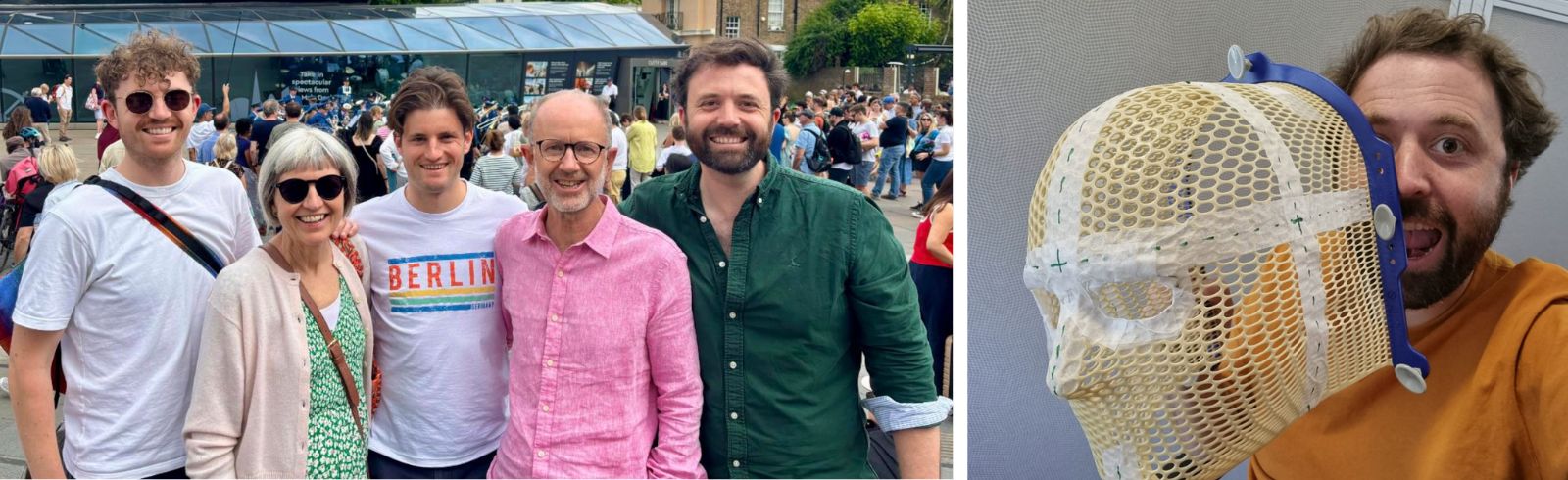
Ed, 38, was on a skiing holiday when he had a seizure out of the blue, leading to the discovery of a brain tumour. He had debulking surgery in the UK and was diagnosed with an astrocytoma, IDH-mutant. Ed returned to Sydney, where he’d been living and teaching for four years, to have radiotherapy and chemotherapy. He moved back to the UK in December 2022 and is now living in South East London, helping Brain Tumour Research raise awareness of the disease.

Ed tells his story…
My brain tumour was a sudden discovery rather than a build-up of symptoms over time. In January 2022, I went to Italy on a skiing holiday. I’d travelled there from Sydney.
I skied into some deep snow and sat myself down to re-jig my boots and realised the sensation was disappearing on my left side. I couldn’t control movement in my left leg and blacked out. I came round to paramedics putting me on a stretcher and into a helicopter. I was airlifted to Aosta Hospital a short distance away where I learned I’d had a seizure with blood coming from my mouth.

After a CT scan, X-ray and EEG (electroencephalogram - a test that records the electrical activity of the brain using electrodes attached to the scalp), I was placed on anti-epilepsy medication due to the risk of another seizure and the next day was told there was something in my head. On the advice of the Italian doctors, I went back to my family home in Ipswich in the UK as the flight was much shorter than going back to Australia and I could find out exactly what was happening.
Ipswich Hospital referred me to Addenbrooke’s Hospital in Cambridge where I met Professor Stephen Price who confirmed I had a brain tumour.
This came with a whole blend of emotions and feelings. Fear about what my diagnosis meant but also shock and adrenaline.
I was also thinking practically about what happens next.
I was given three options: to have a craniotomy to debulk the tumour, a biopsy which takes a small sample of tumour before deciding on a treatment plan, or watch and wait to see what happens.

Much discussion with my family and Professor Price led to my decision to have surgery, which took place on 7 February. It felt mad that less than a month after a seizure completely out of the blue, I was in an operating theatre because I had suspected brain cancer.

I felt well looked after and as though I was receiving cutting-edge treatment. Before surgery, I had to drink ‘the pink drink’ which, ironically, is clear. It made my tumour cells fluoresce pink under UV light and is called 5-ALA (5-aminolevulinic acid). It’s designed to help the neurosurgeon operate with greater precision.
I was diagnosed with an astrocytoma IDH-mutant which I was told carries a better prognosis than other types.
The tumour was close to my motor strip which controls the left side of my body.
After surgery I had to relearn the full range of motion in my fingers and legs, I could move them, but it was very sluggish.
As a music teacher who used to play the piano, I can still play, but not as well and have taken to singing more than playing instruments.
I understood what I was dealing with and thought I can’t hide from it; the only way is through and one way I could help myself was by going back to a familiar routine. A month after my operation, in March I travelled back to Sydney for the rest of my treatment.

From April to June, I had 33 blasts of radiotherapy which I had at hospital as soon as I finished my working day. It became part of my normal life and when radiotherapy finished, I had six months of oral chemotherapy called temozolomide (TMZ) which I was thrilled about because it meant I didn’t have to go into hospital or travel anywhere.
Chemo made me feel a bit rubbish and messed with my gut, but I didn’t let my diagnosis dictate my life.
The disease made me realise I wanted to be back in England and after finishing treatment, I travelled around the Australian outback before returning to Ipswich on Christmas Eve and spent time with my parents and two brothers. I then moved to Brockley in South East London where I work in an International School teaching English and music.
My mum went to a friend’s fundraising event in aid of Brain Tumour Research, and when I looked into the charity, I knew I wanted to support it too. Its focus on science and treatment really spoke to me, it’s been such an abiding theme throughout my own experience. The power of research means everything.

In September, I’m going to run two half marathons within a week of each other, one in Guernsey (14 September) which is the home of a good friend who loves running, and the second in Ipswich which is my hometown, finishing at Portman Road Stadium, the home of my beloved football club.

The good thing about running is that it doesn’t need skill such as agility, I can just keep moving forward with momentum and lots of training.
I’m fundraising for Brain Tumour Research because I want more people to understand how devastating brain cancer can be, especially the high-grade types. I know someone with a glioblastoma and have seen the impact first-hand and how it turns lives upside down. My brother worked with a woman who lost her teenage son to the disease. Once you start talking about it, you quickly realise how many people have been affected.
It’s shocking that brain tumours kill more children and adults under the age of 40 than any other cancer, yet just 1% of the national spend on cancer research has been allocated to brain tumours since records began in 2002. It simply doesn’t get the airtime or funding it deserves, and that’s what I want to help change.
Ed Jennings
July 2025
One in three people in the UK knows someone affected by a brain tumour. This disease is indiscriminate; it can affect anyone at any age. What’s more, brain tumours continue to kill more children and adults under the age of 40 than any other cancer yet, to date, just 1% of the national spend on cancer research has been allocated to this devastating disease since records began in 2002.
Brain Tumour Research is determined to change this.
If you have been inspired by Ed’s story, you may like to make a donation via www.braintumourresearch.org/donate or leave a gift in your will via www.braintumourresearch.org/legacy
Together we will find a cure.
